Blackjack Online: How to Play Free, Learn Rules and Try Demo

Last updated: June 2026. This guide is for informational purposes only. Gambling involves financial risk. Please play responsibly and follow the laws of your jurisdiction.

What Blackjack Is and Why Players Choose It Online. Blackjack is, at its core, a card game where you compete against the dealer. The goal? Get a hand value closer to 21 than the dealer without going o

What Blackjack Is and Why Players Choose It Online

Blackjack is, at its core, a card game where you compete against the dealer. The goal? Get a hand value closer to 21 than the dealer without going over. That sounds simple, and in many ways it is. But the reason casino blackjack stands apart from pure chance games like slots or roulette is the layer of decision-making built into every hand. When to hit, when to stand, whether to double or split: these choices directly shape your odds.

That blend of luck and skill is what keeps the blackjack game relevant after centuries of play.

Online blackjack generated 42% of global online table game revenue in 2023, outpacing roulette at 28% and baccarat at 15%, according to H2 Gambling Capital's 2024 market analysis. The driving force behind this dominance is the game's low house edge. With optimal play, blackjack offers a house edge of roughly 2 to 3%, compared to 5 to 15% for most slots and 2.7 to 5.26% for roulette (UK Gambling Commission, 2024 report on game fairness). A peer-reviewed study in the Journal of Behavioral Decision Making (2023) found that 68% of strategic players prioritize math-based games such as blackjack, while 74% of slot players cite entertainment over odds.

Players in India increasingly choose blackjack online because it offers immediate access, flexible stakes, and a wide range of formats. You can jump into rapid-fire RNG tables, try free blackjack in demo mode, or sit at an immersive live dealer room. Whether you want an online casino environment or a no-risk demo to practice, the combination of low house edge, strategic depth, and convenience explains why this game dominates the digital gambling landscape.

Worth noting: free and demo modes let you explore the rules without any financial pressure, which makes blackjack one of the most beginner-friendly games blackjack casinos offer.

How to Play Blackjack Step by Step. A standard round of blackjack follows a clear six-step sequence. Understanding this flow is essential before you explore strategy or game variations. **Step 1: Plac

How to Play Blackjack Step by Step

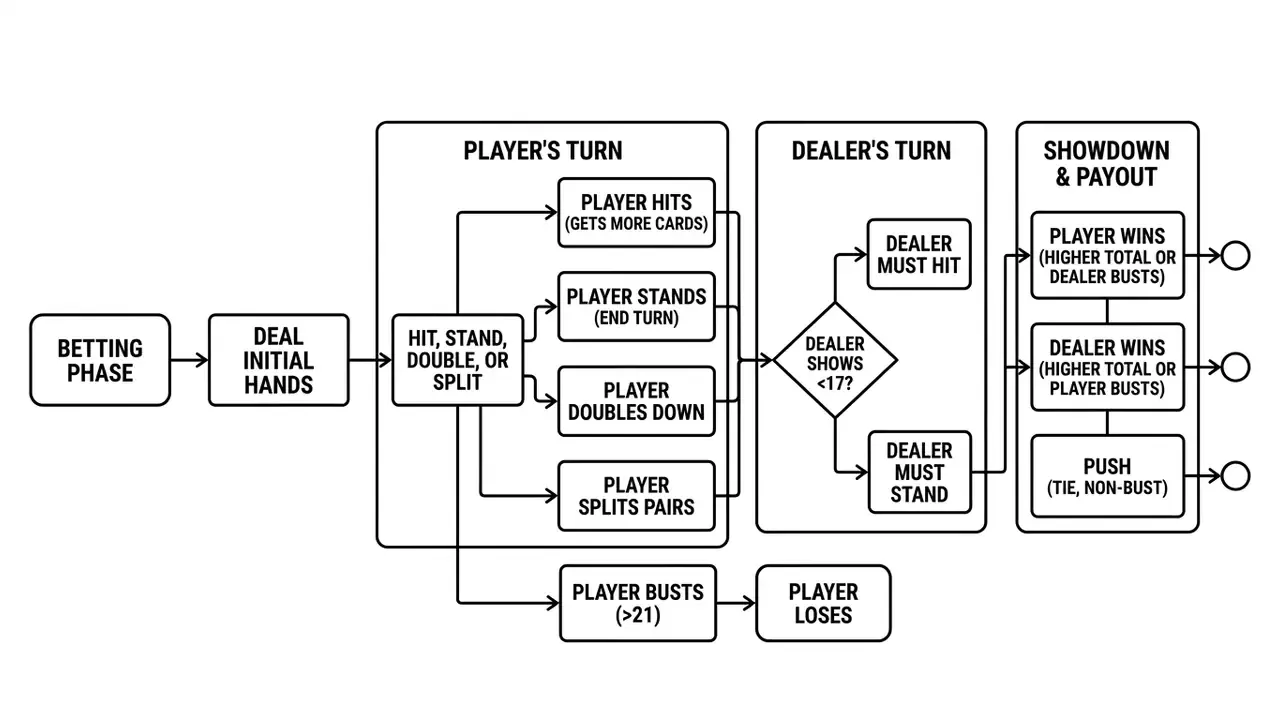
A standard round of blackjack follows a clear six-step sequence. Understanding this flow is essential before you explore strategy or game variations.

Step 1: Place Your Bet. Before any cards are dealt, select your chip value and place your wager in the designated betting area. Many tables also offer optional side bets such as Perfect Pairs or 21+3 at this stage.

Step 2: Receive Two Cards. The dealer distributes two cards to each player (both face up in most online versions) and two to themselves. One dealer card is face up (the "upcard") and one face down (the "hole card").

Step 3: Dealer Checks for Blackjack. If the dealer's upcard is an Ace or a 10-value card, the dealer peeks at the hole card to check for a natural blackjack (Ace + 10-value card = 21). If the dealer has blackjack, the round ends immediately and all players without a matching natural lose their bets.

Step 4: Player Actions. Starting from the dealer's left, each player decides in turn: Hit, Stand, Double Down, Split, or Surrender. These decisions form the strategic core of the blackjack game and are discussed in detail below.

Step 5: Dealer Draws. After all players have acted, the dealer reveals the hole card and draws according to fixed house rules. Typically, the dealer stands on 17 or higher and hits on 16 or lower.

Step 6: Compare and Pay Out. Hands are compared. Players who beat the dealer's total without busting are paid 1:1. A natural blackjack on the initial two cards traditionally pays 3:2. Ties ("pushes") return the original bet.

Research into training algorithms has shown that even the order in which players learn these actions matters. A 2026 arXiv preprint on curriculum-based learning found that agents introduced to actions in a carefully sequenced "action curriculum" achieved up to a 3.4% increase in win rate, a 4.9% reduction in bust rate, and required 74% fewer training examples to reach competency ("Learning to Play Blackjack: A Curriculum Learning Perspective," arXiv, 2026). For human learners, the takeaway is practical: mastering the basics in sequence builds a stronger foundation than jumping straight to advanced strategy.

Card Values and the Objective of the Game

Understanding card values is the first prerequisite for any blackjack decision.

CardValue
2 to 10Face value (e.g., 7 = 7 points)
Jack, Queen, King10
Ace1 or 11 (player's choice)

Here is the part that trips up many beginners: the objective is not simply to reach 21. You need to achieve a hand total closer to 21 than the dealer's hand, without exceeding 21 (known as "busting"). This distinction matters because it means standing on a low total can sometimes be the correct play, especially if the dealer is likely to bust.

"Even in simplified blackjack variants targeting a value of 13, the structure of card values generates non-trivial strategic decisions." - "Basic Strategy for Some Simplified Blackjack Variants," arXiv preprint, 2024.

Card values confirmed by the Nevada Gaming Control Board (2023): cards 2 to 10 are worth their face value, face cards always equal 10, and the Ace's dual value (1 or 11) creates the strategic distinction between soft and hard hands.

Hit, Stand, Double, Split and Surrender. Each player action carries specific strategic implications. Here are clear definitions and when to consider each move: **Hit** means you request one additional

Hit, Stand, Double, Split and Surrender

Each player action carries specific strategic implications. Here are clear definitions and when to consider each move:

Hit means you request one additional card. Use this when your hand total is low enough that the risk of busting is outweighed by the chance of improving your hand. For instance, hitting on 11 is nearly always correct because no single card can cause a bust.

Stand means you keep your current hand total and end your turn. Stand when your hand is strong enough to likely beat the dealer, or when the dealer's upcard suggests a high probability of them busting.

Double Down means you double your initial bet in exchange for receiving exactly one more card. This is most advantageous when your starting two cards total 10 or 11, giving you a strong chance of landing on 20 or 21 with a single draw.

Split applies when your first two cards form a pair (e.g., 8-8 or Ace-Ace). You may separate them into two independent hands, each receiving one additional card. A second bet equal to the original is placed on the new hand. Important restriction: when splitting Aces, most casinos allow only one additional card per hand and prohibit re-splitting or doubling after the split.

Surrender means you forfeit half your bet and end the hand immediately. Two variants exist:

  • Early Surrender: Available before the dealer checks for blackjack. More valuable but rarely offered.
  • Late Surrender: Available only after the dealer has checked for blackjack. This is the more common form in modern casinos.

Surrender is typically correct only in very specific situations, such as holding a hard 16 against a dealer showing 10.

Blackjack Rules That Affect Every Hand

The rules of blackjack are not universal. They vary by jurisdiction, casino operator, and software provider. Players exploring different iGaming formats will encounter significant rule differences that directly affect the house edge. Understanding these rules before you sit down at any table, whether online or in a live setting, is genuinely important.

Soft Hands, Hard Hands and Dealer Rules. **Soft hand:** A hand containing an Ace counted as 11 without exceeding 21. For example, Ace + 6 = soft 17. The hand is "soft" because an additional card canno

Soft Hands, Hard Hands and Dealer Rules

Soft hand: A hand containing an Ace counted as 11 without exceeding 21. For example, Ace + 6 = soft 17. The hand is "soft" because an additional card cannot cause a bust. The Ace simply reverts to 1 if needed.

Hard hand: A hand without an Ace, or one where the Ace must be counted as 1 to avoid busting. For example, 10 + 7 = hard 17, or 10 + 6 + Ace = hard 17.

Dealer standing rules have a measurable impact on the player's expected return. There are two common rules:

  • Dealer stands on all 17s (S17): The dealer does not draw on any hand totaling 17, including soft 17. This is more favorable for the player.
  • Dealer hits soft 17 (H17): The dealer draws an additional card on soft 17. This gives the dealer a chance to improve the hand, costing the player approximately 0.22% in expected value compared to the S17 rule ("Blackjack: A Player's Guide," Stanford Wong, 2023).

"Optimal blackjack strategies must maximize long-term financial returns while avoiding player ruin." - "Variations on the Reinforcement Learning Performance of Blackjack," arXiv, 2023.

When choosing an online blackjack table, always check whether the dealer stands or hits on soft 17. Over thousands of hands, that 0.22% difference compounds significantly. It is a small detail that separates informed playing blackjack from guesswork.

Insurance, Side Bets and Payout Terms. **Insurance:** When the dealer's upcard is an Ace, players are offered "insurance," a side wager equal to half the original bet that pays 2:1 if the dealer has b

Insurance, Side Bets and Payout Terms

Insurance: When the dealer's upcard is an Ace, players are offered "insurance," a side wager equal to half the original bet that pays 2:1 if the dealer has blackjack. While this appears protective, the math is unfavorable. Insurance has a house edge of approximately 7.4% in a standard multi-deck game. Over time, taking insurance consistently costs money.

Side Bets: Perfect Pairs and 21+3. Side bets are optional wagers placed alongside the main hand. Two of the most popular:

  • Perfect Pairs: Wins if your initial two cards form a pair. Typical payout: 6:1. House edge: approximately 10.36% (Wizard of Odds, 2024).
  • 21+3: Combines your two cards with the dealer's upcard to form a three-card poker hand. Wins on a pair, flush, straight, or straight flush. Typical payout: 9:1. House edge: approximately 3.37% (Wizard of Odds, 2024).

Side bets usually carry significantly higher house edges than the main blackjack game. While they add excitement, players focused on long-term value should know that these wagers erode bankrolls faster than the base game.

Payout Terms: 3:2 vs. 6:5. The payout for a natural blackjack is one of the most important factors affecting the house edge:

PayoutPlayer receives on ₹1,000 betApproximate house edge
3:2₹1,500~0.50%
6:5₹1,200~2.80%

Switching from a 3:2 to a 6:5 payout increases the house edge by approximately 2.30% (Wizard of Odds, "Blackjack Payout Variations," 2024). Always verify the payout terms before sitting down at any table. This single rule change can quietly triple the casino's advantage.

Basic Blackjack Strategy for Better Decisions. Basic blackjack strategy is a mathematically derived set of optimal decisions for every possible combination of player hand versus dealer upcard. It was

Basic Blackjack Strategy for Better Decisions

Basic blackjack strategy is a mathematically derived set of optimal decisions for every possible combination of player hand versus dealer upcard. It was first published in 1956 by Robert Baldwin, Wilbert Cantey, Herbert Maisel, and James McDermott, collectively known as "The Four Horsemen" of blackjack, in the Journal of the American Statistical Association. Their work, later refined by Edward Thorp (1962) and Peter Griffin (1987), proved that a player following perfect basic strategy could reduce the casino's built-in advantage from roughly 5% to between 0.15% and 0.50% depending on the specific rule set.

In traditional single-deck blackjack with favorable rules, fully correct basic strategy can bring the house edge to well under 1%.

However, in many contemporary multi-deck, 6:5-payout games, the edge remains higher, often around 1.5 to 2% even with perfect play, because the unfavorable payout structure more than offsets the strategic gains.

Despite the mathematical precision of basic strategy, the house retains an edge over the long run.

"The best reinforcement-learning agent achieved a win rate of approximately 43%, yet cumulative average reward remained negative over long horizons." - Doctoral thesis, Arizona State University, 2023.

This finding underscores a fundamental truth: no strategy can overcome the house edge in the long run. Basic blackjack strategy minimizes losses and maximizes the entertainment value of each unit wagered. It does not guarantee profit.

How to Use a Basic Strategy Chart. A basic strategy chart is a grid that tells you the statistically best action for every situation. Here is how to read it: 1. **Find your hand on the left side (vert

How to Use a Basic Strategy Chart

A basic strategy chart is a grid that tells you the statistically best action for every situation. Here is how to read it:

  1. Find your hand on the left side (vertical axis). Charts are divided into three sections: Hard hands (no Ace, or Ace counted as 1), Soft hands (Ace counted as 11), and Pairs (two cards of equal value).
  2. Find the dealer's upcard on the top (horizontal axis). Values range from 2 through Ace.
  3. Look at the intersection. The cell tells you whether to Hit (H), Stand (S), Double Down (D), Split (P), or Surrender (R).

Example: You hold a hard 14 and the dealer shows a 7. Find "14" on the left axis and "7" on the top axis. The chart indicates Hit. The reason: with the dealer showing 7, they are likely to make a hand of 17 or better, so your 14 is probably not good enough to win by standing.

What rules does the standard chart assume? The most widely published basic strategy chart for online play assumes 8 decks, dealer stands on all 17s, double down allowed on any initial hand, one split per hand, split Aces receive only one card, no double down after split, and no surrender. Under these rules, the house edge is 0.61%, equivalent to an RTP (return to player) of 99.39%.

If the rules at your chosen table differ, say fewer decks, dealer hits soft 17, or surrender is available, the optimal strategy shifts slightly. Always match your chart to the table rules. This is especially important in demo blackjack, where you can practice without risk.

Common Mistakes When Playing Blackjack

Novice players often make costly errors that inflate the house edge well beyond the theoretical minimum. Here are the most "expensive" mistakes, quantified by their impact on expected value (EV) per hand:

MistakeEV Cost per HandWhy It Hurts
Standing on 16 vs. dealer 7-0.40 unitsHitting gives a 30% win rate vs. 22% for standing (Stanford Wong, 2023).
Splitting a pair of 10s-0.33 unitsA single 20 wins far more often than two separate hands starting from 10 (Edward Thorp, 2022).
Refusing to double on 11-0.27 unitsDoubling on 11 yields a ~50% win rate vs. ~35% for hitting alone (Peter Griffin, 2021).
Always taking insurance-0.07 units (approx.)Insurance carries a ~7.4% house edge. Declining it is always correct for basic-strategy players.
**Myth: "Blackjack is pure luck."** Not quite. While luck determines which cards appear, your decisions about hit, stand, double, and split directly affect the mathematical outcome. A player using bas

Myth: "Blackjack is pure luck." Not quite. While luck determines which cards appear, your decisions about hit, stand, double, and split directly affect the mathematical outcome. A player using basic strategy faces a house edge under 1%. A player making random decisions faces a house edge of 5% or more. The difference is real.

Myth: "Insurance helps you win." Insurance is a separate side bet on whether the dealer has a 10-value hole card. Since only 4 out of 13 card ranks (30.8%) are worth 10, the 2:1 payout does not compensate for the frequency of losing the insurance wager. Over time, the insurance bet costs approximately 7.4 cents per dollar wagered.

Myth: "Free games train wrong habits." Actually, demo blackjack games run on the same RNG software as real-money games. The algorithms and return-to-player percentages are identical. What demo mode cannot replicate is the emotional pressure of real-money decisions, but the rules and probabilities are the same.

Myth: "Other players' mistakes affect your odds." In blackjack, each player's hand is independent. The only competition is between you and the dealer. A bad play by the person next to you is equally likely to help or hurt you in the long run. This misconception has been debunked by multiple gambling researchers, including Don Schlesinger in Blackjack Attack.

Free Blackjack, Blackjack Demo and Real-Money Play

Disclaimer: The information in this section is general in nature and does not replace professional advice. Gambling carries financial risk. Play responsibly and in accordance with the legislation of your jurisdiction.

Free blackjack, blackjack demo modes, and real-money play are three distinct experiences. Understanding the differences helps you pick the right starting point. Free-play blackjack, whether on a casin

Free blackjack, blackjack demo modes, and real-money play are three distinct experiences. Understanding the differences helps you pick the right starting point.

Free-play blackjack, whether on a casino site in demo mode or on a dedicated practice platform, lets you learn the rules, test strategies, and familiarize yourself with game interfaces without risking real money. Demo games use virtual credits (often $100,000 or more) that reset every session, giving you unlimited freedom to experiment.

Modern free blackjack games run on HTML5, meaning they work directly in any web browser on desktop, tablet, or mobile. No downloads or plugins required. The obsolete Flash technology was officially discontinued in 2020 and is no longer supported by any major browser.

Crucially, demo games run on the same RNG software as real-money games. The algorithms, probabilities, and return-to-player percentages are identical. Only the currency (virtual vs. real) differs. The myth that demo games have "looser" settings is false. Both modes use cryptographically secure, third-party-audited random number generators.

The key technical distinction lies not in the algorithms but in certification. Casino demo-mode RNGs are identical to their real-money counterparts, certified to standards such as NIST SP 800-90B. Free social blackjack games (those found on non-casino entertainment apps) may use pseudo-random generators without third-party audit. The difference is regulatory oversight, not computational sophistication (eCOGRA, 2024).

When Free Blackjack Is the Best Choice. Free blackjack is the best choice when you want to:

When Free Blackjack Is the Best Choice

Free blackjack is the best choice when you want to:

  • Learn without risk:Understand Hit, Stand, Double Down, and Split before wagering real money.
  • Test strategy:Practice basic blackjack strategy, experiment with bet sizing, and explore new variants.
  • Evaluate interfaces:Check a game's speed, layout, and features before committing.
  • Build confidence:Play hundreds of hands until the rules feel natural.
How to play blackjack for free: visit a site offering blackjack demo games, click on the game (no signup or deposit is required on most platforms), and virtual credits load automatically. Place bets,

How to play blackjack for free: visit a site offering blackjack demo games, click on the game (no signup or deposit is required on most platforms), and virtual credits load automatically. Place bets, play hands, and experiment. Credits reset when you exit, so you never run out.

If you prefer to play at an online casino, many operators offer a "Fun Mode" or "Demo" option alongside their real-money games. Some casinos may require basic registration (email and username) before enabling free play.

One practical note for Indian players: not all jurisdictions allow unrestricted access to free demos. In the United Kingdom, the UKGC (since 2021) requires full registration and identity verification (KYC) before players can access any game content, including demos. The Netherlands (Kansspelautoriteit) enforces a similar prohibition. Within the broader EU, regulations vary by country. In India, the regulatory landscape for online gambling is state-specific, so always check local rules.

What Changes in Real-Money Blackjack

The transition from free to real-money blackjack introduces several important differences:

Bankroll matters. In demo mode, virtual credits are infinite. In real-money play, every chip represents actual money. This changes how you think about bet sizing, loss limits, and session length.

Psychological pressure is real. Research has shown that free-play modes can influence subsequent gambling behavior in important ways:

"Players exposed to 'profitable' demo modes placed significantly higher bets in subsequent real-money play." - "Exposure to Free-Play Modes in Simulated Online Gaming Increases Risk-Taking in Monetary Gambling," 2014.

"Playing computerized blackjack for points intensified craving for gambling regardless of outcome." - "Post-cue Exposure Craving and Its Association with Amount Wagered in an Optional Betting Task," 2014.

A study from the UNLV Harrah College of Hospitality found that completely eliminating free-play bonuses reduced casino visit frequency by approximately 20%, although per-visit spending remained largel

A study from the UNLV Harrah College of Hospitality found that completely eliminating free-play bonuses reduced casino visit frequency by approximately 20%, although per-visit spending remained largely unchanged ("The Diminishing Impact of Casino Free-Play Promotions").

These findings highlight the importance of self-awareness when transitioning from free to real-money play. The excitement generated by demo wins can create unrealistic expectations about real-money outcomes. Pop-up warnings and responsible-gambling messages tested alongside demo modes showed no significant moderating effect on subsequent betting behavior, reinforcing the need for players to set strict personal limits before making the switch.

House edge and terms become consequential. In demo mode, a 6:5 payout versus a 3:2 payout is an abstract difference. In real-money blackjack, that 2.30% house edge increase costs you real money over hundreds of hands. The same applies to wagering requirements on bonuses, withdrawal limits, and KYC verification timelines.

Bonus terms deserve scrutiny. Casino bonuses often come with wagering requirements that disadvantage blackjack players. While slot bets typically contribute 100% toward wagering requirements, blackjack bets usually contribute only 5 to 10%. This means a ₹10,000 bonus with a 30x wagering requirement effectively requires ₹3,000,000 to ₹6,000,000 in blackjack bets to clear, compared to ₹300,000 in slot bets. Always read the full terms and conditions before accepting any bonus.

Live Blackjack vs Standard Online Blackjack. Live dealer blackjack streams a real human dealer, dealing physical cards on a real table, directly to your screen via high-definition video. These games e

Live Blackjack vs Standard Online Blackjack

Live dealer blackjack streams a real human dealer, dealing physical cards on a real table, directly to your screen via high-definition video. These games emerged in the mid-2000s and have since become one of the fastest-growing segments in online gambling.

In live blackjack, the source of randomness is a physical deck of cards, often dealt from a shoe containing 6 or 8 decks. Cards are tracked using RFID chips and optical scanners that verify every dealt card in real time, ensuring complete traceability and fairness (Evolution Gaming, 2024). "Smart shufflers" with built-in RFID validation automate the shuffle between shoes.

By contrast, standard online blackjack (RNG) generates outcomes entirely through certified software algorithms (NIST SP 800-90B), with no physical components. This allows for much faster gameplay.

RNG tables typically deliver 200 to 300 hands per hour, compared to 50 to 70 for live tables. That speed difference may intensify both variance and the rate at which bankrolls are consumed.

Social interaction is another key difference. Live tables feature real-time chat with the dealer and, on some tables, with other players. This social dimension is one of the primary draws for players who find RNG tables too clinical or impersonal.

Can you play live blackjack for free? Neither Evolution Gaming nor Ezugi, the two dominant live casino providers, offers fully free live games against real dealers. The costs of operating live studios (dealer salaries, equipment, streaming infrastructure) make free play economically unviable. The alternatives for non-wagering participants are:

Crickex heading-banner
  • Bet Behind:Watch another player's hand and optionally place a bet on their outcome.
  • Spectating mode:Some platforms allow you to observe a live table without placing any bets.
  • "First Person" games:Evolution offers computer-animated versions of its live games (e.g., First Person Blackjack) that replicate the live experience visually but are powered by RNG software, making them available in demo mode.
ParameterStandard Online Blackjack (RNG)Live Blackjack
Source of randomnessCertified software (RNG)Physical cards + RFID verification
Speed200 to 300 hands/hour50 to 70 hands/hour
Minimum bet₹10 to ₹100₹500 to ₹2,500
Free demo available?YesNo (Bet Behind / First Person only)
Social interactionNoneReal-time dealer and player chat
Card counting feasible?No (deck reshuffled every hand)Theoretically possible but extremely difficult with continuous shuffle machines
Best forLearning rules, practicing strategyImmersive casino experience

For beginners, standard online blackjack in demo mode is the most comfortable starting point. Live blackjack is better suited for players who already know the rules and want a more social, casino-like atmosphere.

How to Choose a Blackjack Online Casino

Not all online casinos are created equal. Before depositing real money, verify several key factors. This is especially relevant for Indian players, where payment methods, KYC processes, and regulatory clarity vary widely.

Features Worth Checking Before You Play. **Licensing and Regulation.** Choose casinos licensed by Tier-1 regulators: - **UK Gambling Commission (UKGC):** License number must be visible in the site foo

Features Worth Checking Before You Play

Licensing and Regulation. Choose casinos licensed by Tier-1 regulators:

  • UK Gambling Commission (UKGC): License number must be visible in the site footer (Section 5.1 of License Conditions).
  • Malta Gaming Authority (MGA): Enforces player fund segregation and transparent dispute resolution.

Audit Certificates. Look for current certification from independent testing labs:

  • eCOGRA: Certifies fair play, RNG integrity, and accurate payout percentages via annual audits.
  • iTech Labs / BMM Testlabs: Provides RNG certification and payout verification, with certificates valid for 12 months unless re-audited.

Available blackjack games. Check whether the casino offers a range of blackjack games, including classic, multi-hand, and live dealer options. The presence of demo mode is a strong positive signal. It means the platform is confident enough in its games to let you try before you deposit.

Mobile usability. For Indian players, mobile-first access matters. Touch-responsive card interaction with minimal latency (under 100ms) prevents misclicks during fast-paced hands. Test the mobile experience before committing.

Payment clarity. Look for INR support, UPI availability, and clear withdrawal timelines. Fast cashout processing (under 5 minutes on instant-payment rails) increases confidence and reduces friction.

Terms transparency. Blackjack-specific terms to check: wagering contribution percentage, bet limits in bonus mode, and whether live blackjack bets count toward wagering requirements.

Signs a Blackjack Offer Is Worth Trying. A good blackjack offer is not about the biggest bonus number. Here is what actually signals value: - **Demo and free play available** without deposit. This let

Signs a Blackjack Offer Is Worth Trying

A good blackjack offer is not about the biggest bonus number. Here is what actually signals value:

  • Demo and free play available without deposit. This lets you evaluate the game quality and interface before risking money.
  • Clear, readable terms. If the bonus terms page is longer than the game rules, that is a red flag.
  • 3:2 blackjack payouts on the main tables. Avoid casinos that only offer 6:5.
  • Dealer stands on all 17s (S17) as the default rule. This gives you a lower house edge.
  • Smooth transition from demo to real mode. The best platforms let you switch with one click, keeping your game preferences intact.
  • Popular blackjack games from reputable providers. Evolution Gaming, Pragmatic Play Live, and Playtech publish official RTP lists on their websites (e.g., evolution.com/help/rtplist, pragmaticplay.com/live-games/rules, playtech.com/games/rtplist), offering independently verified figures for each game variant.

Official rules pages from casino operators and game providers are reliable sources for verifying variations and terms. Cross-referencing these with independent calculators like the Wizard of Odds strengthens your confidence in the numbers.

Best Blackjack Game Variations to Know Before You Play. The rules of blackjack are not fixed across all tables. Different variations change the strategy, the bets, and the house edge. Here are the mos

Best Blackjack Game Variations to Know Before You Play

The rules of blackjack are not fixed across all tables. Different variations change the strategy, the bets, and the house edge. Here are the most common ones you will encounter:

Classic Blackjack (8-deck, S17, 3:2). This is the standard format for most online blackjack games. House edge with perfect basic strategy: approximately 0.50 to 0.61%. Ideal for beginners because the rules are straightforward and strategy charts are widely available.

Single-Deck Blackjack. Fewer decks reduce the house edge (by roughly 0.58% compared to 6-deck games), but casinos often compensate with less favorable rules like 6:5 payouts. Always check the full rule set before assuming single-deck is automatically better.

Blackjack Switch. Invented by Geoff Hall, this variant deals each player two hands and allows swapping the top card of each hand. To offset this advantage, dealer 22 results in a push against all non-busted player hands (excluding natural blackjacks). With optimal play, the house edge drops to approximately 0.17% (Wizard of Odds, Michael Shackleford, 2023), one of the lowest of any table game.

European Blackjack. The dealer receives only one card face up initially and does not peek for blackjack. This changes the strategy for hands like 11 against a dealer Ace. The no-peek rule slightly increases the house edge.

Live Dealer Variants. Live formats from Evolution, Pragmatic Play, and Playtech often include unique features like side bets, multiplier mechanics, or VIP tables with higher limits. The core blackjack rules remain the same, but the pace and atmosphere differ significantly from RNG games.

Key rule variations and their impact on house edge:

Rule ChangeEffect on House Edge
6:5 payout instead of 3:2+2.30%
Dealer hits soft 17 instead of standing+0.22%
6 decks instead of single deck+0.58% (approx.)
No surrender allowed+0.07% (approx.)

Before you play any variation, check the specific rules at your table. Even small rule differences compound over hundreds of hands.

Skills You Can Train in Demo Mode

Demo mode is most effective for certain skills and less effective for others. Here is an honest breakdown:

SkillDemo EffectivenessWhy
Basic strategy memorizationExcellent (90 to 95%)Instant feedback, zero risk, unlimited repetition.
Game interface navigationExcellentLearn buttons, bet placement, and payout display risk-free.
Basic Hi-Lo card countingLow (20 to 30%)RNG games shuffle the deck every hand, making running counts meaningless.
True Count trackingVery lowRequires a continuous shoe, which is impossible in standard RNG games.
Emotional disciplineLowNo real money means no real stress. The psychological gap is significant.
In RNG blackjack, algorithms shuffle the deck with each hand, making card counting ineffective. If you want to practice counting, use a dedicated card-counting trainer app that simulates a continuous

In RNG blackjack, algorithms shuffle the deck with each hand, making card counting ineffective. If you want to practice counting, use a dedicated card-counting trainer app that simulates a continuous shoe (such as the Bojoko Blackjack Simulator's counting drill).

Bankroll management systems you can stress-test for free. One of the most practical uses of demo mode is stress-testing bankroll management systems before risking real capital:

Flat Betting means wagering the same amount every hand. This is the most conservative approach. In demo, you can verify that your bankroll survives extended losing streaks (10+ hands) without dramatic swings.

Martingale means doubling your bet after every loss, reverting to the base bet after a win. Demo testing quickly exposes the system's fatal flaw: after just 10 consecutive losses starting from a ₹100 base bet, the next wager is ₹102,400, and total losses have reached ₹102,300. In 95% of simulations, this sequence leads to bankroll depletion when starting with a modest balance.

D'Alembert means increasing the bet by one unit after a loss, decreasing by one unit after a win. Gentler than Martingale but still carries approximately a 30% probability of ruin after 15 consecutive losses in simulated runs.

1-3-2-6 System is a positive-progression system where bet units follow the sequence 1, 3, 2, 6, resetting to 1 after a completed cycle or any loss. Demo testing shows modest profits (1 to 2%) during winning streaks of 4+ hands, but the system offers no mathematical edge over the house.

No betting system can overcome the house edge. These systems manage variance and risk of ruin, not expected value. Demo testing helps you understand how quickly each system can deplete a bankroll under realistic conditions.

Player Tracking and Responsible Gambling

Online casinos collect detailed logs of every hand, bet, and session duration. Researchers have used these datasets to study behavioral patterns, including risky tendencies that players should be aware of:

"Detailed eCasino logs allow tracking of how players increase bets after losses or wins within a single session." - "Within-Session Chasing of Losses and Wins in an Online eCasino," 2024.

**Loss chasing** (increasing bets after a loss to "recover") and **win chasing** (increasing bets after a win due to overconfidence) are two of the most common patterns identified. Both behaviors are

Loss chasing (increasing bets after a loss to "recover") and win chasing (increasing bets after a win due to overconfidence) are two of the most common patterns identified. Both behaviors are associated with increased total losses and shorter session durations.

Understanding that casinos track these patterns, and that the patterns are detrimental to the player, can serve as an important self-check. If you find yourself consistently raising bets after losses, it is a signal to take a break, revisit your bankroll management plan, or consider the responsible-gambling tools that licensed casinos are required to provide.

Responsible gambling tools available at most licensed casinos:

  • Deposit limits (daily, weekly, monthly)
  • Session time reminders
  • Loss limits
  • Self-exclusion options (temporary or permanent)
  • Reality checks that display total time and money spent

Set limits before you begin. Not after. The best blackjack player is not the one who wins the most in a single session. It is the one who makes consistently correct decisions, manages risk wisely, and knows when to walk away.

If you or someone you know is struggling with gambling, resources like the National Council on Problem Gambling (ncpgambling.org) and BeGambleAware (begambleaware.org) offer free, confidential support.

FAQ About Blackjack Online, Free Play and Demo Mode

Respuestas renderizadas en formato acorde al diseГ±o exportado: tarjetas oscuras, acento dorado y despliegue compacto.

1

Can You Play Blackjack Online Free Without Registration?

On most practice sites and many online casinos, yes. Look for a "Demo" or "Fun Mode" button next to the blackjack game. No download, no registration, no deposit required. Virtual credits load automatically.

However, in regulated jurisdictions like the UK and the Netherlands, even demo access requires full registration and identity verification (KYC). In India, access policies vary by platform. Some casinos may require a basic email signup before enabling free play, while others offer instant demo access.

2

Is Blackjack Demo Useful Before Playing for Real?

Absolutely, for specific skills. Demo blackjack is excellent for learning rules, memorizing basic blackjack strategy, and getting comfortable with the game interface. You can play hundreds of hands without financial pressure, which builds genuine confidence.

Where demo falls short: it cannot replicate the emotional intensity of real-money decisions. The psychological gap between virtual credits and real money is significant. Players who dominate in demo mode sometimes struggle with discipline when real stakes are involved.

The practical approach is to use demo mode until basic strategy feels automatic, then transition to real-money play with strict limits already set.

3

Can You Play Live Blackjack for Free?

Not in the traditional sense. Live dealer games require real-money bets because the costs of operating live studios (dealer salaries, equipment, streaming infrastructure) make free play economically unviable.

The closest alternatives:

  • Spectating mode on some platforms lets you watch a live table without placing bets.
  • Bet Behind lets you watch another player's hand and optionally place a bet on their outcome.
  • Evolution's "First Person" series offers RNG-based games with a live-game visual style that can be played in demo mode. These are not true live games, but they give you a feel for the interface and pacing.

Some platforms occasionally run promotional events where limited free live blackjack hands are available, but these are rare and typically come with specific terms.

4

Are There Mobile Blackjack Apps?

Yes. Modern blackjack games are built on HTML5 and play directly in mobile browsers without a dedicated app. Some platforms also offer downloadable apps (iOS and Android) with additional features like offline play and training drills. For Indian players using UPI or mobile wallets, browser-based play is often the most convenient option.
5

What Is the Best Blackjack Variant for Beginners?

Classic blackjack with standard rules (8 decks, dealer stands on all 17s, 3:2 payout) is ideal. The house edge under these conditions is approximately 0.61% with perfect basic strategy, and the rules are straightforward enough to learn quickly. Once you are comfortable, you can explore variations like Blackjack Switch or European Blackjack.
6

Do Blackjack Strategies Guarantee Winnings?

No. Basic blackjack strategy reduces the house edge to its mathematical minimum, but it does not eliminate it. Over the long run, the casino retains a small advantage. Strategy improves your decisions and stretches your entertainment budget. It does not turn blackjack into a source of income. Anyone claiming otherwise is not being honest with you.